Monday, October 23, 2006

Star EGGs in the Eagle Nebula

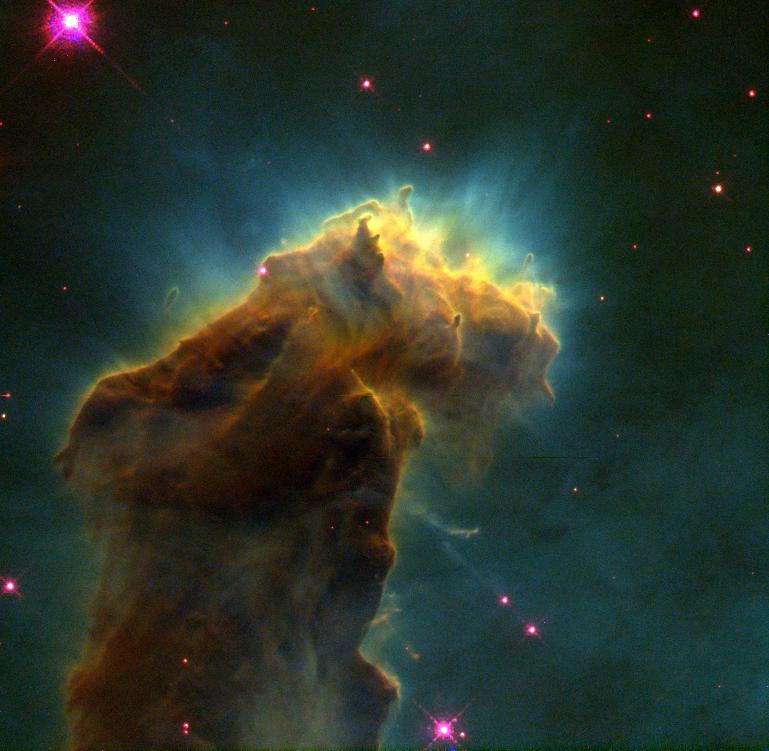
Where do stars form? One place, star forming regions known as "EGGs", are uncovered at the end of this giant pillar of gas and dust in the Eagle Nebula (M16). EGGs, short for evaporating gaseous globules, are dense regions of mostly molecular hydrogen gas that fragment and gravitationally collapse to form stars. Light from the hottest and brightest of these new stars heats the end of the pillar and causes further evaporation of gas - revealing yet more EGGs and more young stars. This picture was taken by the Wide Field and Planetary Camera on board the Hubble Space Telescope.

http://antwrp.gsfc.nasa.gov/apod/ap061022.html

Friday, October 06, 2006

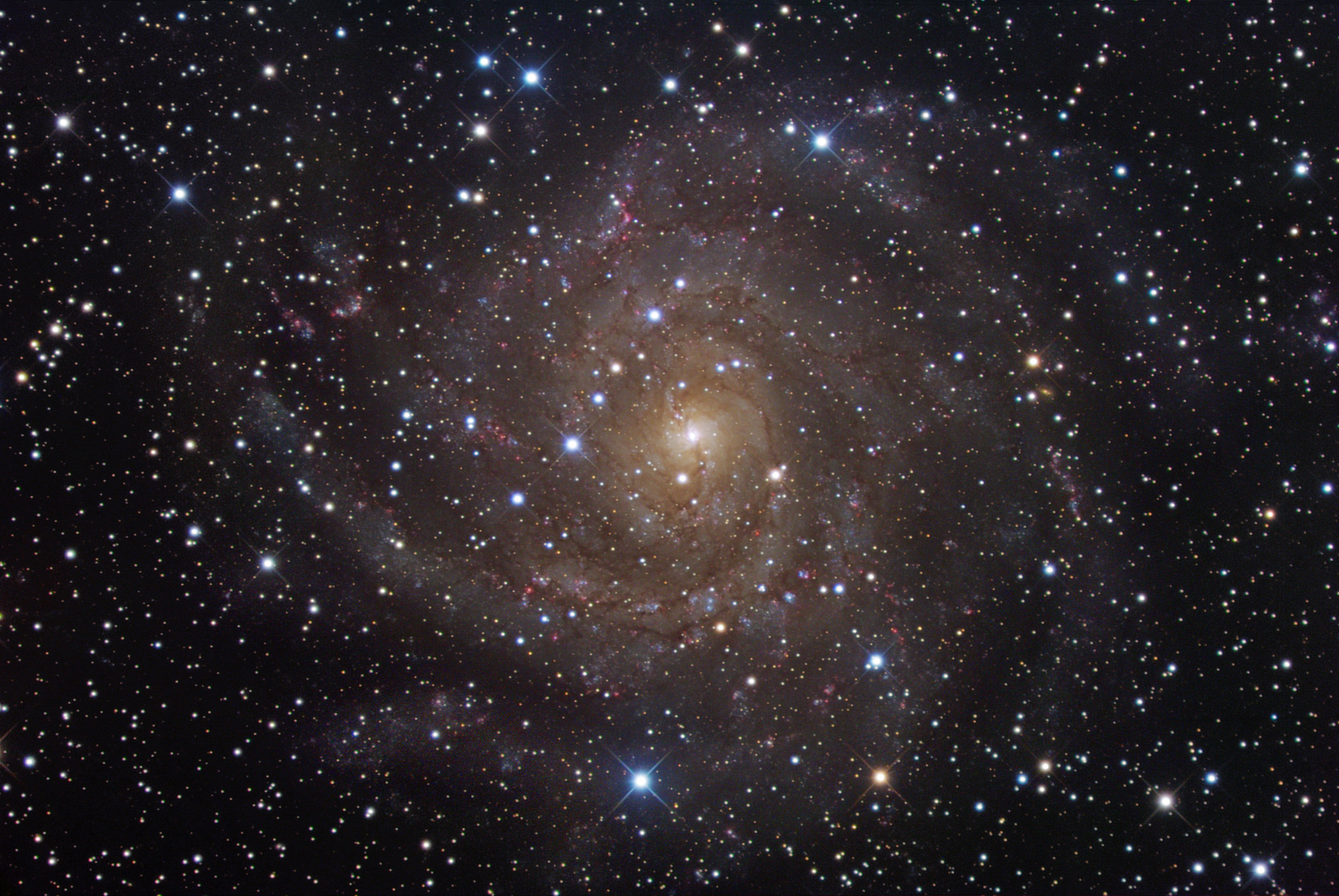
Hidden Galaxy IC 342


Similar in size to other large, bright spiral galaxies IC 342 is a mere 7 million light-years distant in the long-necked, northern constellation Camelopardalis. A sprawling island universe, IC 342 would otherwise be a prominent galaxy in our night sky, but it is almost hidden from view behind the veil of stars, gas and dust clouds in the plane of our Milky Way galaxy. Even though IC 342's light is dimmed by intervening cosmic clouds, this remarkably sharp telescopic image traces the galaxy's own obscuring dust, blue star clusters, and glowing pink star forming regions along spiral arms that wind far from the galaxy's core. IC 342 may have undergone a recent burst of star formation activity and is close enough to have gravitationally influenced the evolution of the local group of galaxies and the Milky Way.

http://antwrp.gsfc.nasa.gov/apod/ap061005.html

Orbiting a Red Dwarf Star

This artist's concept of a gas giant planet orbiting a red dwarf K star shows a planet has not been directly imaged, but its presence was detected in 2003 microlensing observations of a field star in our galaxy. Gravitational microlensing happens when a foreground star amplifies the light of a background star that momentarily aligns with it. Follow-up observations by Hubble Space Telescope in 2005 separated the light of the slightly offset foreground star from the background star. This allowed the host star to be identified as a red dwarf star located 19,000 light-years away. The Hubble observations allow for the planet's mass to be estimated at 2.6 Jupiter masses. The characteristics of the lensing event show that the planet is in a Jupiter-sized orbit around its parent red star. The rings and moon around the gas giant are hypothetical, but plausible, given the nature of the family of gas giant planets in our solar system.

http://www.nasa.gov/multimedia/imagegallery/image_feature_671.html

Thursday, October 05, 2006

An Unwelcome Place for New Stars

This artist's concept depicts a supermassive black hole at the center of a galaxy. NASA's Galaxy Evolution Explorer found evidence that black holes -- once they grow to a critical size -- stifle the formation of new stars in elliptical galaxies. Black holes are thought to do this by heating up and blasting away the gas that fuels star formation.

The blue color here represents radiation pouring out from material very close to the black hole. The grayish structure surrounding the black hole, called a torus, is made up of gas and dust. Beyond the torus, only the old red-colored stars that make up the galaxy can be seen. There are no new stars in the galaxy.

http://www.nasa.gov/multimedia/imagegallery/image_feature_670.html

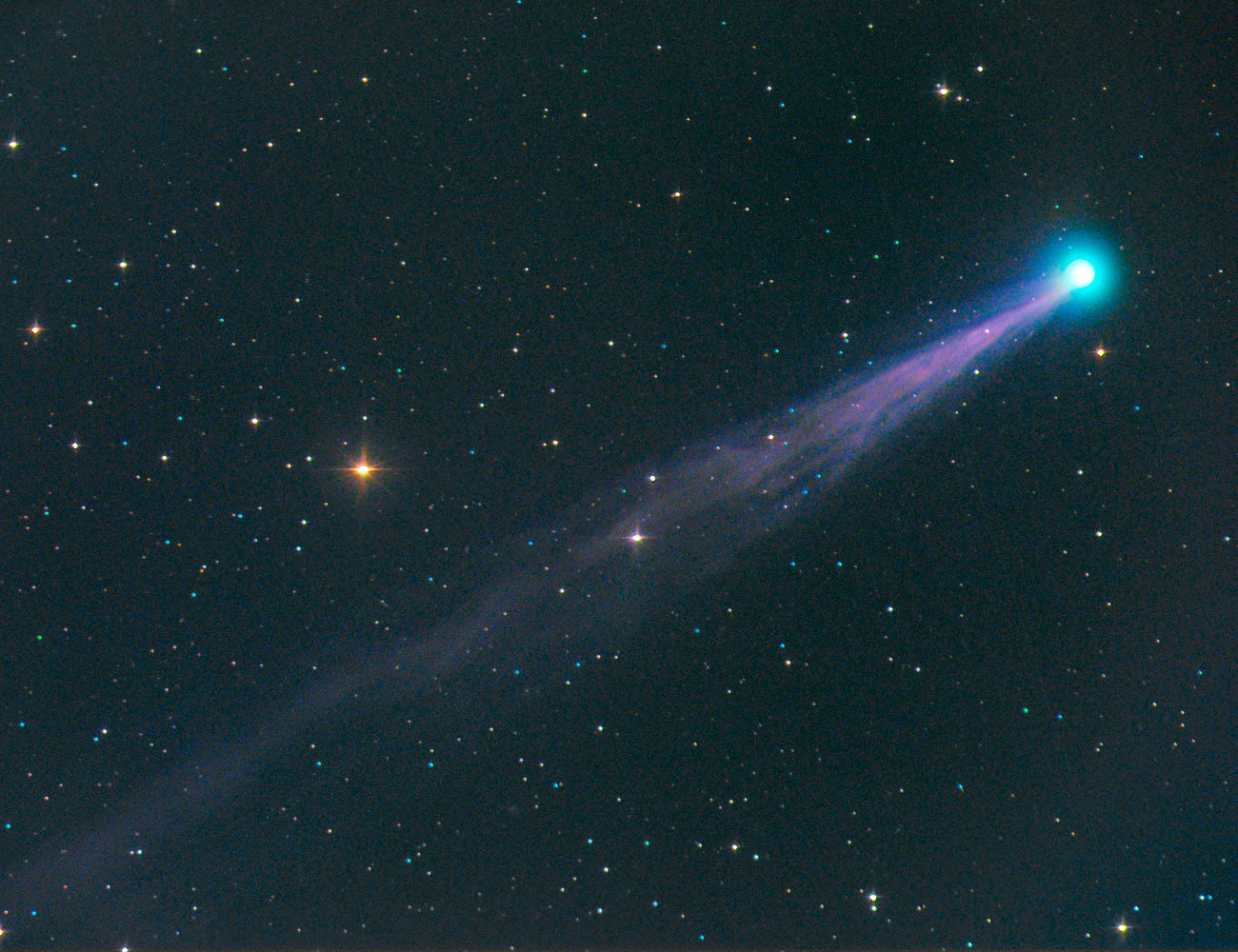
Comet SWAN Brightens

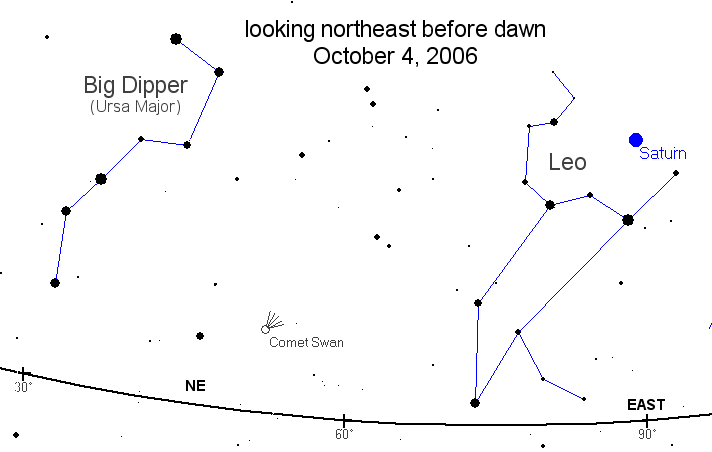
A newly discovered comet has brightened enough to be visible this week with binoculars. The picturesque comet is already becoming a favored target for northern sky imagers. Pictured above just last week, Comet SWAN showed a bright blue-green coma and an impressive tail. Comet C/2006 M4 (SWAN) was discovered in June in public images from the Solar Wind Anisotropies (SWAN) instrument of NASA and ESA's Sun-orbiting SOHO spacecraft. Comet SWAN, near magnitude six, will be visible with binoculars in the northeastern sky not far from the Big Dipper over the next few days before dawn. The comet is expected to reach its peak brightness this week. Passing its closest to the Sun two days ago, Comet SWAN and will be at its closest to the Earth toward the end of this month. Comet SWAN's unusual orbit appears to be hyperbolic, meaning that it will likely go off into interstellar space, never to return.

http://antwrp.gsfc.nasa.gov/apod/ap061004.html

Tuesday, October 03, 2006

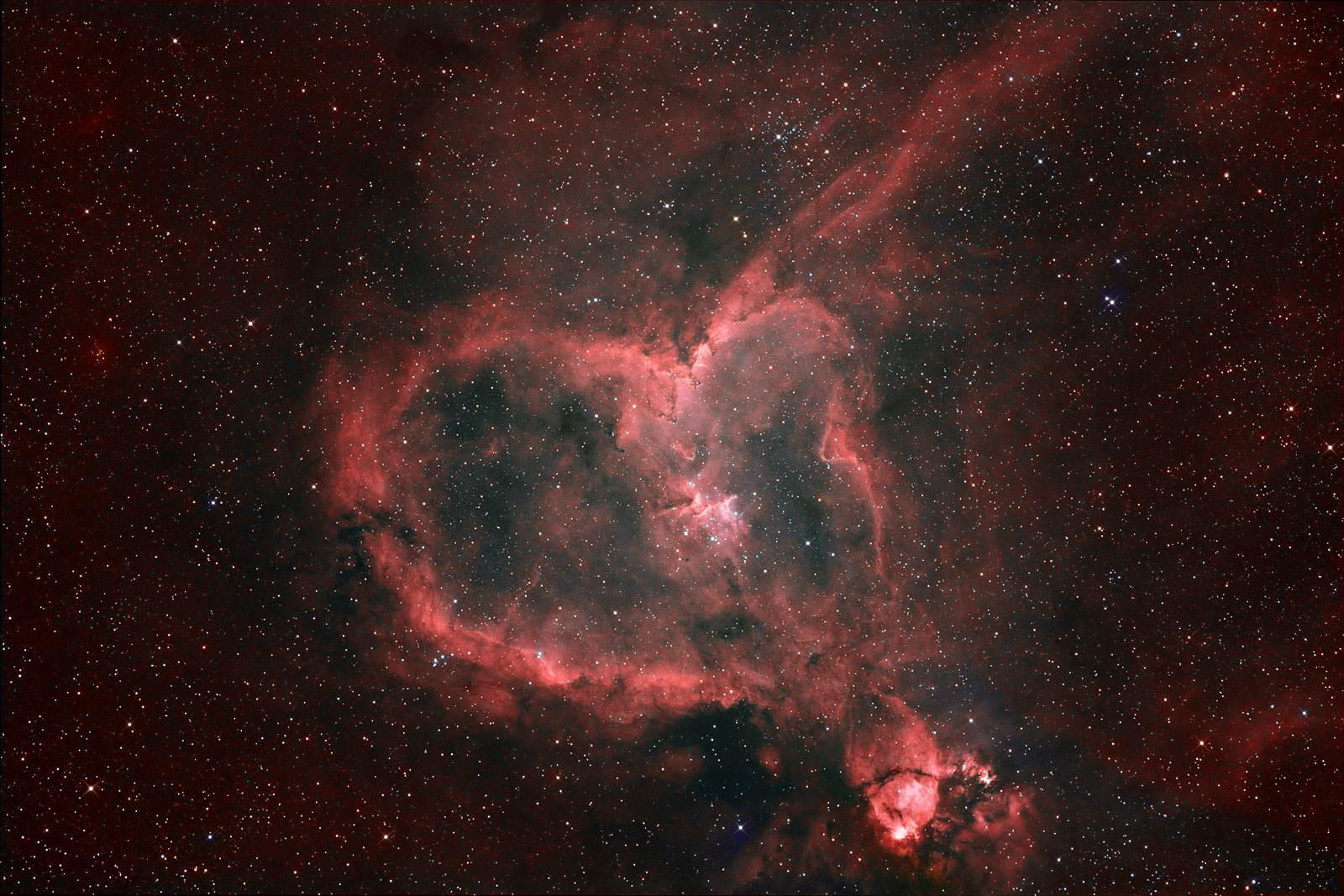
Light from the Heart Nebula


What powers the Heart Nebula? The large emission nebula dubbed IC 1805 looks, in whole, like a human heart. The nebula glows brightly in red light emitted by its most prominent element: hydrogen. The red glow and the larger shape are all created by a small group of stars near the nebula's center. A close up spanning about 30 light years contains many of these stars is shown above . This open cluster of stars contains a few bright stars nearly 50 times the mass of our Sun, many dim stars only a fraction of the mass of our Sun, and an absent microquasar that was expelled millions of years ago. The Heart Nebula is located about 7,500 light years away toward the constellation of Cassiopeia.

http://antwrp.gsfc.nasa.gov/apod/ap061003.html

NASA Observes the Antarctic Ozone Hole


When daylight returns to the South Pole after the total darkness of the polar winter, it sets off a series of chemical reactions that destroy ozone in the stratosphere. As spring progresses in the Southern Hemisphere, NASA satellites observe the resulting development of the Antarctic “ozone hole,” an area of exceptionally low concentrations of stratospheric ozone. The hole begins to develop in mid-August each year and peaks in late September or early October. As summer approaches, weather conditions become less favorable for the ozone-destroying reactions, and the ozone layer stabilizes until the next spring.

This image from September 29, 2006, shows the ozone concentration in the stratosphere above the South Pole observed by the Ozone Monitoring Instrument on NASA’s Aura satellite. Greens and yellows show areas with the highest ozone amounts, while blues and purples show where ozone amounts are lowest. A purple veil of extremely low levels of ozone stretches across most of Antarctica, which is roughly centered in the image.

Scientists generally use Dobson Units to describe ozone concentrations. Ozone in the atmosphere isn’t packed into a single layer at a certain altitude above the Earth’s surface; it’s dispersed. The Dobson Unit describes how much ozone there would be in a column of the atmosphere if all the molecules were squeezed into a single layer. One Dobson Unit is the number of molecules of ozone that would be required to create a layer of pure ozone 0.01 millimeters thick at a temperature of 0 degrees Celsius and a pressure of 1 atmosphere (the air pressure at the surface of the Earth).

The average amount of ozone in the atmosphere is roughly 300 Dobson Units, equivalent to a layer 3 millimeters (0.12 inches) thick—the height of 2 pennies stacked together. Any place where the concentration drops below 220 Dobson Units is considered part of the ozone hole. Average ozone concentrations in the ozone hole are around 100 Dobson Units—about the height of a dime. Stratospheric ozone absorbs ultraviolet (UV) light that can be dangerous to living things. A thinner ozone layer increases humans’ and other creatures’ exposure to harmful UV light.

NASA measurements made by aircraft- and ground-based sensors in the 1980s provided much of our initial understanding of the extent of the ozone hole and its link to the chemicals known as chlorofluorocarbons (CFCs), which human activities were releasing into the atmosphere. In 1987, the Montreal Protocol banned the worst of the ozone-destroying chemicals. Today, NASA scientists are using the latest tools—including satellite observations and computer models of atmospheric chemistry and weather—to determine what effect the ban on CFCs and related chemicals has had and how long we will have to wait for a full ozone layer recovery. NASA shares the latest information and satellite images of the ozone hole with the public on its Ozone Watch Website.

NASA image provided by the Ozone Hole Watch Website.
Friday, September 29, 2006

What's Old is New in the Large Magellanic Cloud


This vibrant image from NASA's Spitzer Space Telescope shows the Large Magellanic Cloud, a satellite galaxy to our own Milky Way galaxy. The Large Magellanic Cloud, located 160,000 light-years from Earth, is one of a handful of dwarf galaxies that orbit the Milky Way.

The infrared image offers astronomers a unique chance to study the lifecycle of stars and dust in a single galaxy. Nearly one million objects are revealed for the first time in this Spitzer view, which represents about a 1,000-fold improvement in sensitivity over previous space-based missions. Most of the new objects are dusty stars of various ages populating the Large Magellanic Cloud; the rest are thought to be background galaxies.

The blue color in the picture, seen most prominently in the central bar, represents starlight from older stars. The chaotic, bright regions outside this bar are filled with hot, massive stars buried in thick blankets of dust. The red color around these bright regions is from dust heated by stars, while the red dots scattered throughout the picture are either dusty, old stars or more distant galaxies. The greenish clouds contain cooler interstellar gas and molecular-sized dust grains illuminated by ambient starlight.

Astronomers say this image allows them to quantify the process by which space dust -- the same stuff that makes up planets and even people -- is recycled in a galaxy. The picture shows dust at its three main cosmic hangouts: around the young stars, where it is being consumed (red-tinted, bright clouds); scattered about in the space between stars (greenish clouds); and in expelled shells of material from old stars (randomly-spaced red dots).

http://www.nasa.gov/multimedia/imagegallery/image_feature_666.html

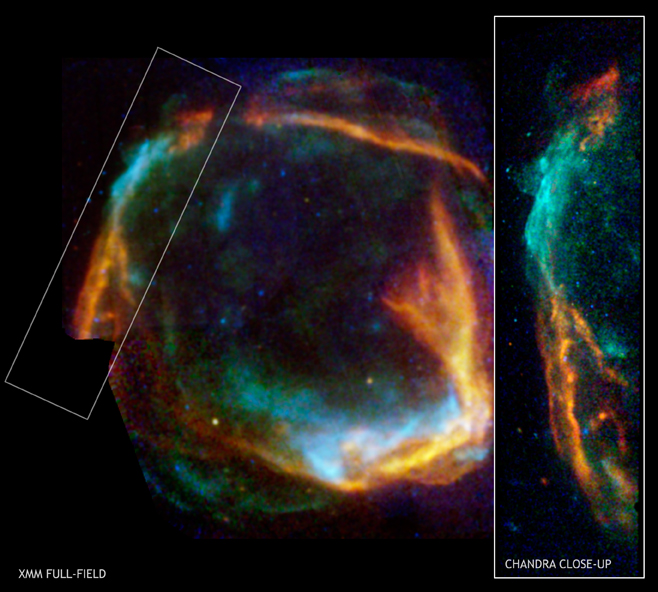
RCW 86: Historical Supernova Remnant

In 185 AD, Chinese astronomers recorded the appearance of a new star in the Nanmen asterism - a part of the sky identified with Alpha and Beta Centauri on modern star charts. The new star was visible for months and is thought to be the earliest recorded supernova. Data from two orbiting X-ray telescopes of the 21st century, XMM-Newton and Chandra, now offer evidence that supernova remnant RCW 86 is indeed the debris from that stellar explosion. Their composite, false-color view of RCW 86 shows the expanding shell of material glowing in x-rays with high, medium, and low energies shown in blue, green, and red hues. Shock velocities measured in the x-ray emitting shell and an estimated radius of about 50 light-years can be used to find the apparent age of the remnant. The results indicate that light from the initial explosion could well have first reached planet Earth in 185 AD. Near the plane of our Milky Way Galaxy, RCW 86 is about 8,200 light-years away.

http://antwrp.gsfc.nasa.gov/apod/ap060928.html

Sunday, September 24, 2006

NGC 1499: The California Nebula

What's California doing in space? Drifting through the Orion Arm of the spiral Milky Way Galaxy, this cosmic cloud by chance echoes the outline of California on the west coast of the United States. Our own Sun also lies within the Milky Way's Orion Arm, only about 1,500 light-years from the California Nebula. Also known as NGC 1499, the classic emission nebula is around 100 light-years long. It glows with the red light characteristic of hydrogen atoms recombining with long lost electrons, stripped away (ionized) by energetic starlight. In this case, the star most likely providing the energetic starlight is the bright, hot, bluish Xi Persei, just right of the nebula and above picture center. Fittingly, this composite picture was made with images from a telescope in California - the 48-inch (1.2-meter) Samuel Oschin Telescope - taken as a part of the second National Geographic Palomar Observatory Sky Survey.

http://antwrp.gsfc.nasa.gov/apod/ap060924.html

Monday, September 18, 2006

Eris: The Largest Known Dwarf Planet

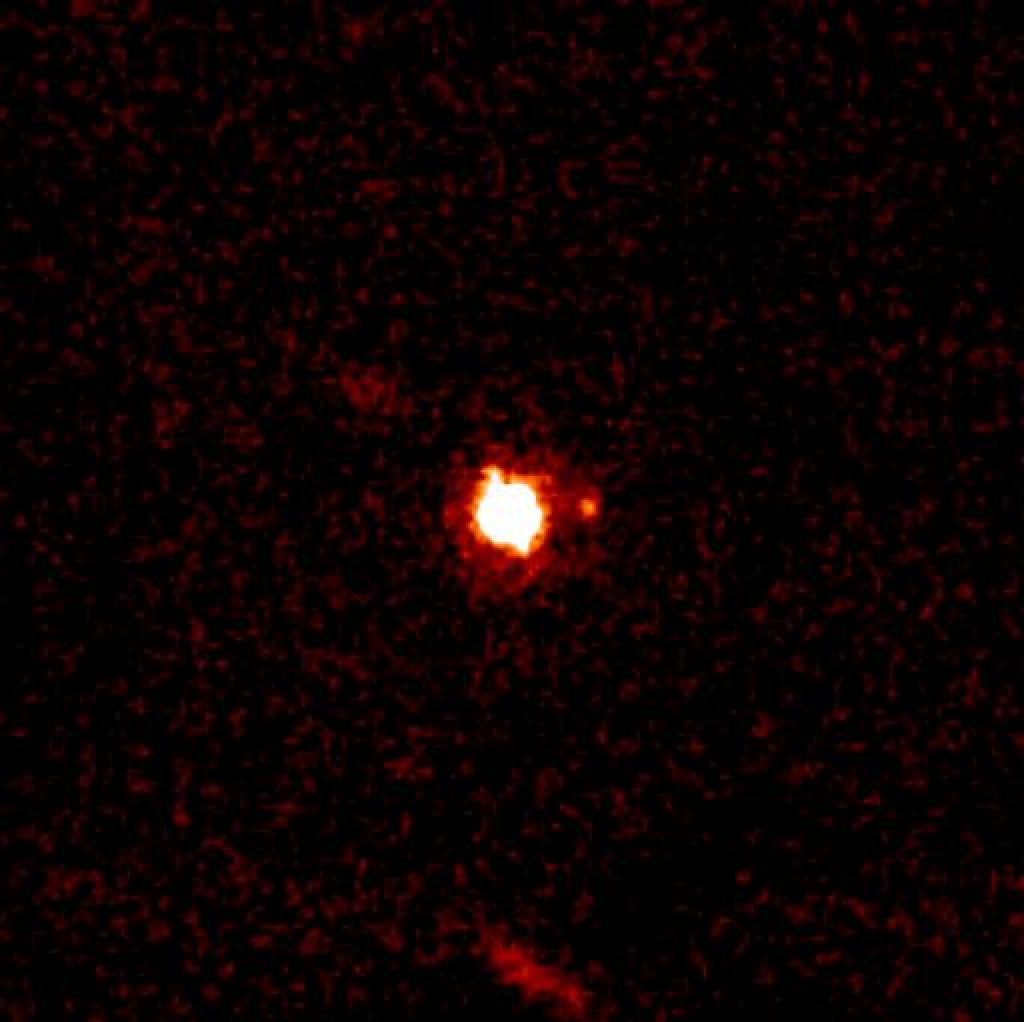
Is Pluto the largest dwarf planet? No! Currently, the largest known dwarf planet is (136199) Eris, renamed last week from 2003 UB313. Eris is just slightly larger than Pluto, but orbits as far as twice Pluto's distance from the Sun. Eris is shown above in an image taken by a 10-meter Keck Telescope from Hawaii, USA. Like Pluto, Eris has a moon, which has been officially named by the International Astronomical Union as (136199) Eris I (Dysnomia). Dysnomia is visible above just to the right of Eris. Dwarf planets Pluto and Eris are trans-Neptunian objects that orbit in the Kuiper belt of objects past Neptune. Eris was discovered in 2003, and is likely composed of frozen water-ice and methane. Since Pluto's recent demotion by the IAU from planet to dwarf planet status, Pluto has recently also been given a new numeric designation: (134340) Pluto. Currently, the only other officially designated "dwarf planet" is (1) Ceres.

http://antwrp.gsfc.nasa.gov/apod/ap060918.html

Friday, September 15, 2006

11 Hour Star Trails

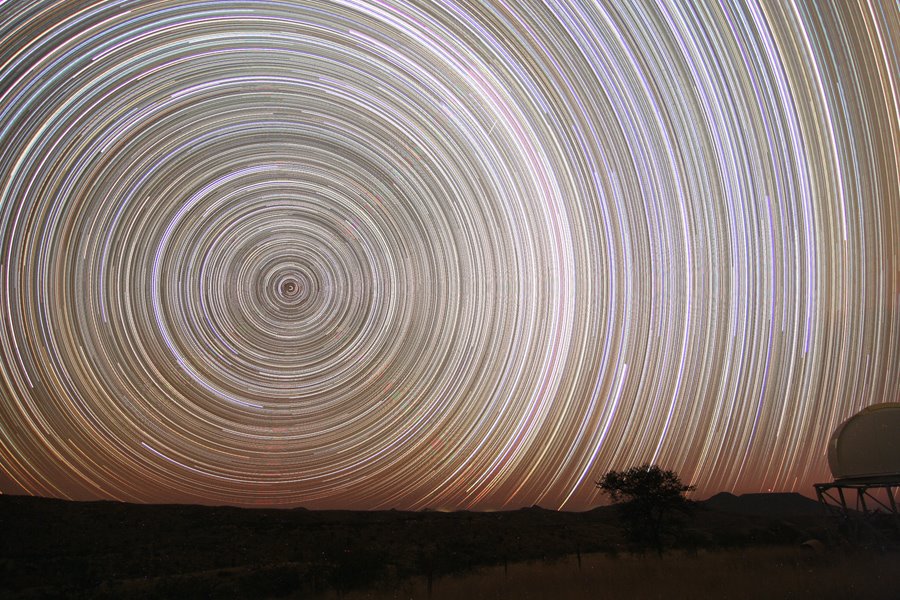
Fix your camera to a tripod, lock the shutter open, and you can make an image of star trails - graceful concentric arcs traced by the stars as planet Earth rotates on its axis. Of course, the length of the star trails will depend on the exposure time. While exposures lasting just five minutes produce a significant arc, in about 12 hours a given star would trace out half a circle. But in any long exposure, the background glow from light-polluted skies can build up to wash out the trails. Still, astronomer Josch Hambsch produced this stunning composite of star trails around the South Celestial Pole with an effective "all night" exposure time of almost 11 hours. To do it, he combined 128 consecutive five minute long digital exposures recorded in very dark night skies above Namibia. In his final image, the background glow on the right is due in part to the faint, arcing Milky Way.

http://antwrp.gsfc.nasa.gov/apod/ap060915.html

Object Larger than Pluto Named Eris

LOS ANGELES (AP)—A distant, icy rock whose discovery shook up the solar system and led to Pluto's planetary demise has been given a name: Eris.

The christening of Eris, named after the Greek goddess of chaos and strife, was announced by the International Astronomical Union on Wednesday. Weeks earlier, the professional astronomers' group stripped Pluto of its planethood under new controversial guidelines.

Since its discovery last year, Eris, which had been known as 2003 UB313, ignited a debate about what constitutes a planet.

Astronomers were split over how to classify the object because there was no universal definition. Some argued it should be welcomed as the 10th planet since it was larger than Pluto, but others felt Pluto was not a full-fledged planet.

After much bickering, astronomers last month voted to shrink the solar system to eight planets, downgrading Pluto to a "dwarf planet,'' a category that also includes Eris and the asteroid Ceres. The new definition states that dwarf planets are not really planets.

Meanwhile this week, Pluto received a numerical designation to reflect its demotion to dwarf planet status.

Eris' discoverer, Michael Brown of the California Institute of Technology, said the name was an obvious choice, calling it "too perfect to resist.''

In mythology, Eris caused a quarrel among goddesses that sparked the Trojan War. In real life, Eris forced scientists to define a planet that eventually led to Pluto getting the boot. Soon after Pluto's dismissal from the planet club, hundreds of scientists circulated a petition protesting the decision.

Eris' moon also received a formal name: Dysnomia, the daughter of Eris known as the spirit of lawlessness.

Eris, which measures about 70 miles wider than Pluto, is the farthest known object in the solar system at 9 billion miles away from sun. It is also the third brightest object located in the Kuiper belt, a disc of icy debris beyond the orbit of Neptune.

Eris had been without a formal name while astronomers grappled over its status. Brown nicknamed it "Xena'' after the fictional warrior princess pending an official designation. He admits the new name will take some getting used to.

"It's a little sad to see Xena go away,'' he said.


http://www.space.com/scienceastronomy/060914_eris_named.html

Thursday, September 14, 2006

M33: Spiral Galaxy in Triangulum

The small, northern constellation Triangulum harbors this magnificent face-on spiral galaxy, M33. Its popular names include the Pinwheel Galaxy or just the Triangulum Galaxy. M33 is over 50,000 light-years in diameter, third largest in the Local Group of galaxies after the Andromeda Galaxy (M31), and our own Milky Way. About 3 million light-years from the Milky Way, M33 is itself thought to be a satellite of the Andromeda Galaxy and astronomers in these two galaxies would likely have spectacular views of each other's grand spiral star systems. As for the view from planet Earth, this detailed, wide field image nicely shows off M33's blue star clusters and pinkish star forming regions which trace the galaxy's loosely wound spiral arms. In fact, the cavernous NGC 604 is the brightest star forming region, seen here at about the 1 o'clock position from the galaxy center. Like M31, M33's population of well-measured variable stars have helped make this nearby spiral a cosmic yardstick for establishing the distance scale of the Universe.

http://antwrp.gsfc.nasa.gov/apod/ap060914.html

Wednesday, September 13, 2006

Water Worlds: Astronomer Predicts Many Earth-Like Planets

To most common terrestrial dwellers, there's no place like Earth. But new simulations show that many Earth-like planets might exist outside of our solar system.

Through computer simulations scientists examined the formation and evolution of giant planet systems recently detected outside the Earth's solar system. Their results revealed that more than a third of them might contain planets that could potentially support life and could even be covered with deep oceans.

The study focuses on a type of planetary system unlike our solar system that contains gas giants known as "hot Jupiters" orbiting extremely close to their parent stars—even closer than Mercury to our sun, said lead author Sean Raymond, a researcher at the University of Colorado at Boulder.

Migrating giants

Hot Jupiters are giant gas planets, with masses close to or greater than that of Jupiter's, orbiting around stars other than our sun.

These giants are believed to have migrated inward toward their parent stars as the planetary systems were forming, disrupting the space environment and triggering the formation of ocean-covered, Earth-like planets in a "habitable zone" conducive to the formation of life, the scientists reported in the Sept. 8 issue of the journal Science.

Hot Jupiters shift around the rotating disks of dense gas surrounding a newly formed star and fling rocky debris outward where they could merge to form planets like Earth, Raymond said.

At the same time, small icy bodies in the outer reaches of the disk are slowed down and pulled in towards the planets by the violent forces from the surrounding gas. These icy formations deliver water to the planets, which can then host huge oceans, the thinking goes.

New thinking

Scientists had previously thought that as hot Jupiters plowed through the dense gaseous material on their inward migrations toward parent stars, all the surrounding material would be either "vacuumed up" or ejected from the system, Raymondsaid. "The new models indicate these early ideas were probably wrong."

After running simulations, based on theories of how the planets form in our solar system, that lasted more than eight months, Raymond and his team concluded that about one of every three known planetary systems could have evolved as Earth-like planets.

"I think there are definitely habitable planets out there," Raymond said. "But any life on these planets could be very different from ours. There are a lot of evolutionary steps in between the formation of such planets in other systems and the presence of life forms looking back at us."

http://www.space.com/scienceastronomy/060912_earthling_planets.html

Tuesday, September 12, 2006

Pluto is Now Just a Number: 134340

Pluto has been given a new name to reflect its new status as a dwarf planet.

On Sept. 7, the former 9th planet was assigned the asteroid number 134340 by the Minor Planet Center (MPC), the official organization responsible for collecting data about asteroids and comets in our solar system.

The move reinforces the International Astronomical Union's (IAU) recent decision to strip Pluto of its planethood and places it in the same category as other small solar-system bodies with accurately known orbits.

Pluto's companion satellites, Charon, Nix and Hydra are considered part of the same system and will not be assigned separate asteroid numbers, said MPC director emeritus Brian Marsden. Instead, they will be called 134340 I, II and III, respectively.

There are currently 136,563 asteroid objects recognized by the MPC; 2,224 new objects were added last week, of which Pluto was the first.

Other notable objects to receive asteroid numbers included 2003 UB313, also known as "Xena," and the recently discovered Kuiper Belt objects 2003 EL61 and 2005 FY9. Their asteroid numbers are 136199, 136108 and 136472, respectively.

The MPC also issued a separate announcement stating that the assignment of permanent asteroid numbers to Pluto and other large objects located beyond the orbit of Neptune "does not preclude their having dual designations in possible separate catalogues of such bodies."

Marsden explained that the cryptic wording refers to the future possibility of creating a separate astronomical catalogue specific to dwarf planets. There might even be more than one catalogue created, he said.

The recent IAU decision implies "that there would be two catalogues of dwarf planets—one for just the trans-Neptunian Pluto type and the other for objects like Ceres, which has also been deemed a dwarf planet," Marsden told SPACE.com. "That's why that statement was put there, to reassure people who think there would be other catalogues that this numbering of Pluto doesn't preclude that."

Pluto's asteroid number was first reported today on the website of Sky and Telescope magazine.

http://feeds.feedburner.com/~r/spaceheadlines/~3/21240702/060911_pluto_asteroidnumber.html

Monday, September 11, 2006

Star Clusters Young and Old

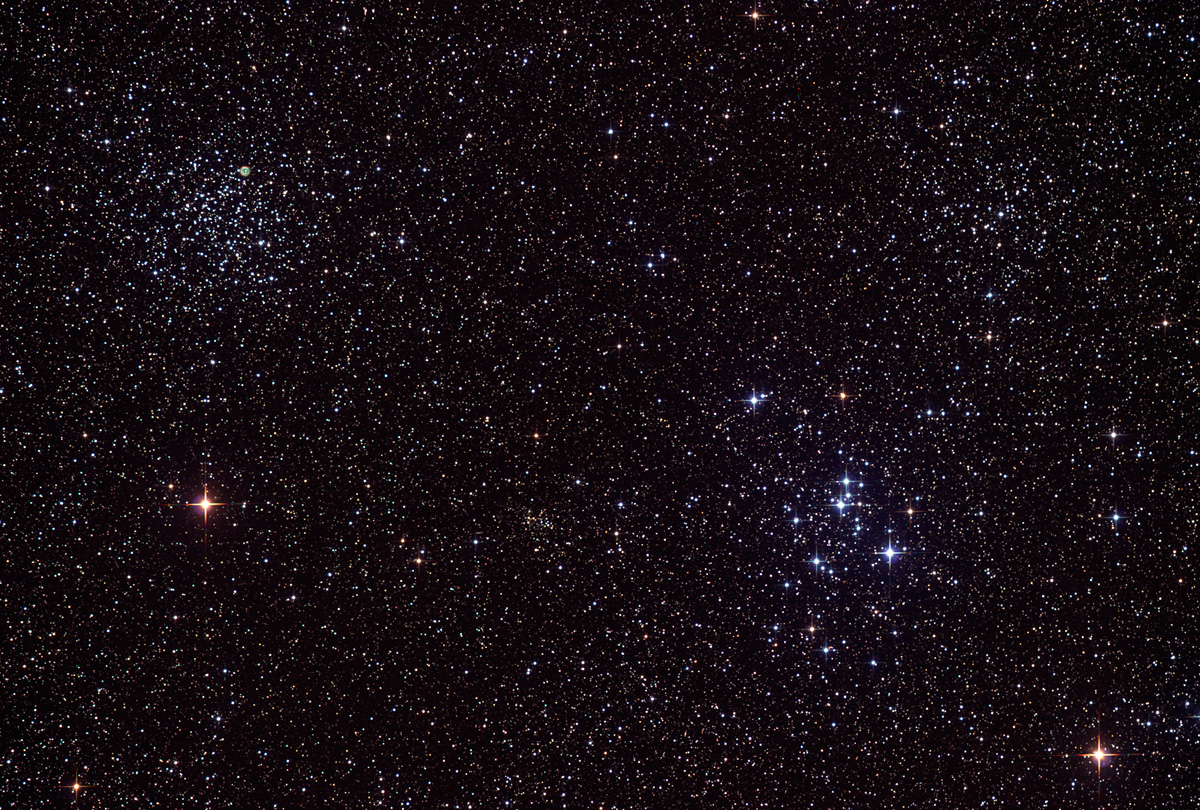
Many stars form in clusters. Galactic or open star clusters are relatively young swarms of bright stars born together near the plane of our Milky Way Galaxy. Separated by about a degree on the sky, two nice examples are M46 (upper left) 5,400 light-years in the distance and M47 (lower right) only 1,600 light-years away toward the nautical constellation Puppis. Around 300 million years young M46 contains a few hundred stars in a region about 30 light-years across. Aged 80 million years, M47 is a smaller but looser cluster of about 50 stars spanning 10 light-years. But this portrait of stellar youth also contains an ancient interloper. The small, colorful patch of glowing gas in M46 is actually the planetary nebula NGC 2438 - the final phase in the life of a sun-like star billions of years old. NGC 2438 is estimated to be only 3,000 light-years distant and likely represents a foreground object, only by chance appearing along our line of sight to youthful M46.

http://antwrp.gsfc.nasa.gov/apod/ap060910.html

Thursday, September 07, 2006

Milky Way: A Crowded Neighborhood

The center of the Milky Way is a crowded neighborhood and not always a calm one, as seen in this image from NASA's Chandra X-ray Observatory. In addition to the supermassive black hole at the center, the area is filled with all sorts of different inhabitants that affect and influence one another.

The image shows three massive star clusters: the Arches (upper right), Quintuplet (upper center), and the GC star cluster (bottom center), which is near the enormous black hole known as Sagittarius A. The massive stars in these clusters can themselves be very bright, point-like X-ray sources, when winds blowing off their surfaces collide with winds from an orbiting companion star. The stars in these clusters also release vast amounts of energy when they reach the ends of their lives and explode as supernovas, which, in turn, heat the material between the stars. The stars near the Galactic Center also can emit X-rays as stellar corpses -- either in the form of neutron stars or black holes in binary systems -- and are also seen as point-like sources in the Chandra image.

http://www.nasa.gov/multimedia/imagegallery/image_feature_649.html

Colorful Moon Mosaic

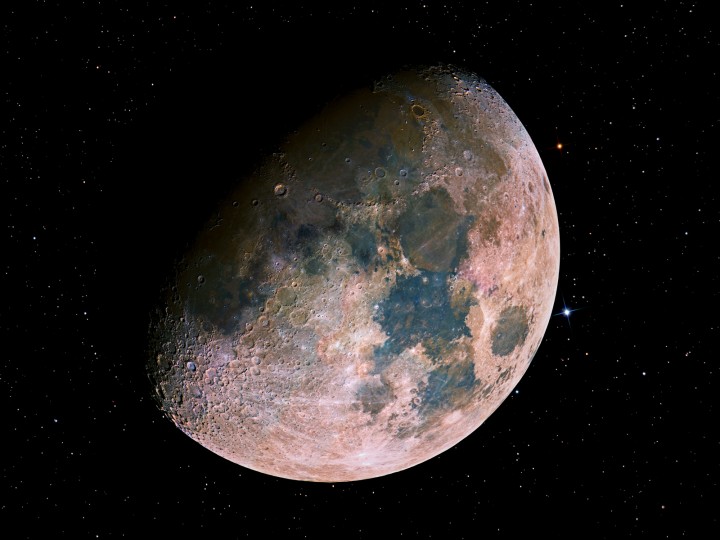
No single exposure can easily capture faint stars along with the subtle colors of the Moon. But this dramatic composite view highlights both. The mosaic digitally stitches together fifteen carefully exposed high resolution images of a bright, gibbous Moon and a representative background star field. The fascinating color differences along the lunar surface are real, though highly exaggerated, corresponding to regions with different chemical compositions. And while these color differences are not visible to the eye even with a telescope, moon watchers can still see a dramatic lunar presentation tonight. A partial eclipse of the Moon will be visible from Europe, Africa, Asia, and Australia.

http://antwrp.gsfc.nasa.gov/apod/ap060907.html

Drought on the Great Plains


Across the Great Plains of the United States and Canada, devastating drought spread across grasslands and croplands in summer 2006. Poor winter snowfall and a blisteringly hot summer following several years of dry conditions have created a dire situation for many farmers and ranchers across the region. According to a recent article on the New York Times Website, many people are comparing the conditions to the Dust Bowl of the 1930s.

The widespread drought conditions are obvious in this vegetation anomaly image based on data from the Moderate Resolution Imaging Spectroradiometer (MODIS) on NASA’s Terra satellite. Places where vegetation is healthier or more abundant than average are green, places where vegetation is about the same as average are pale yellow, and places where vegetation is not as healthy or abundant as average are brown. Gray patches show where no data were available, probably because of persistent clouds. One of the most common satellite-based vegetation maps is a scale, or index, of vegetation greenness called the “NDVI,” short for Normalized Difference Vegetation Index. This image compares NDVI values from July 28-August 12, 2006, to the average values from 2001-2005.

Vegetation was faring worst along the Missouri River through North and South Dakota, but below-average vegetation conditions stretch across parts of Montana, Wyoming, Colorado, northwestern Nebraska, and Minnesota as well. The plains of Canada’s Saskatchewan and Manitoba provinces were suffering drought, too. A few small pockets of green in the image reveal where vegetation greenness values observed by MODIS were higher than average: the mountains of north-central Colorado, southeastern Nebraska, and the Red River Valley. The Red River Valley experienced widespread snowfall and heavy rains in the spring of 2006, leading to significant flooding. The early-season moisture may have helped the vegetation in the area withstand the hot summer. According to the August 29, 2006, update from the U.S. Drought Monitor, most of the Northern Great Plains, as well as much of Oklahoma and Texas, was still in the midst of drought, with many areas falling into the highest category: exceptional drought.


http://earthobservatory.nasa.gov/Newsroom/NewImages/images.php3?img_id=17390